GenieX is an AI-powered educational platform built under the Jovens Gênios ecosystem, designed to deliver personalized ENEM preparation at scale for B2B, B2Gov, and B2C markets through adaptive study plans, intelligent assessments, and real-time performance insights.
Company
GenieX
Timeline
2024
—
2025
Role
Product Designer

Project overview
GenieX was conceived as a new product under the Jovens Gênios technological infrastructure, targeting a different audience: high school and vocational students preparing for ENEM and major entrance exams.
I joined the project alongside another designer to build the platform from scratch. Our responsibility was not only to design an attractive interface, but to transform a complex AI-driven system into a product that delivered tangible academic value to students while remaining commercially viable for institutions.
The challenge was to design an experience that balanced:
Engagement for students
Strategic academic rigor
Data intelligence
Institutional reporting needs
Extensive qualitative research was conducted with high school students actively preparing for ENEM. Through interviews and behavioral analysis, we mapped critical constraints of the exam itself: strict time limits, cognitive fatigue, question pacing (approximately 3 minutes per question), and the psychological pressure of large-scale exams.
The platform needed to simulate reality, optimize performance, and provide clear data-driven direction for improvement — not just content consumption.
Challenges
1. Designing for Performance Under Time Constraints
ENEM is not only about knowledge — it is about time management and endurance.
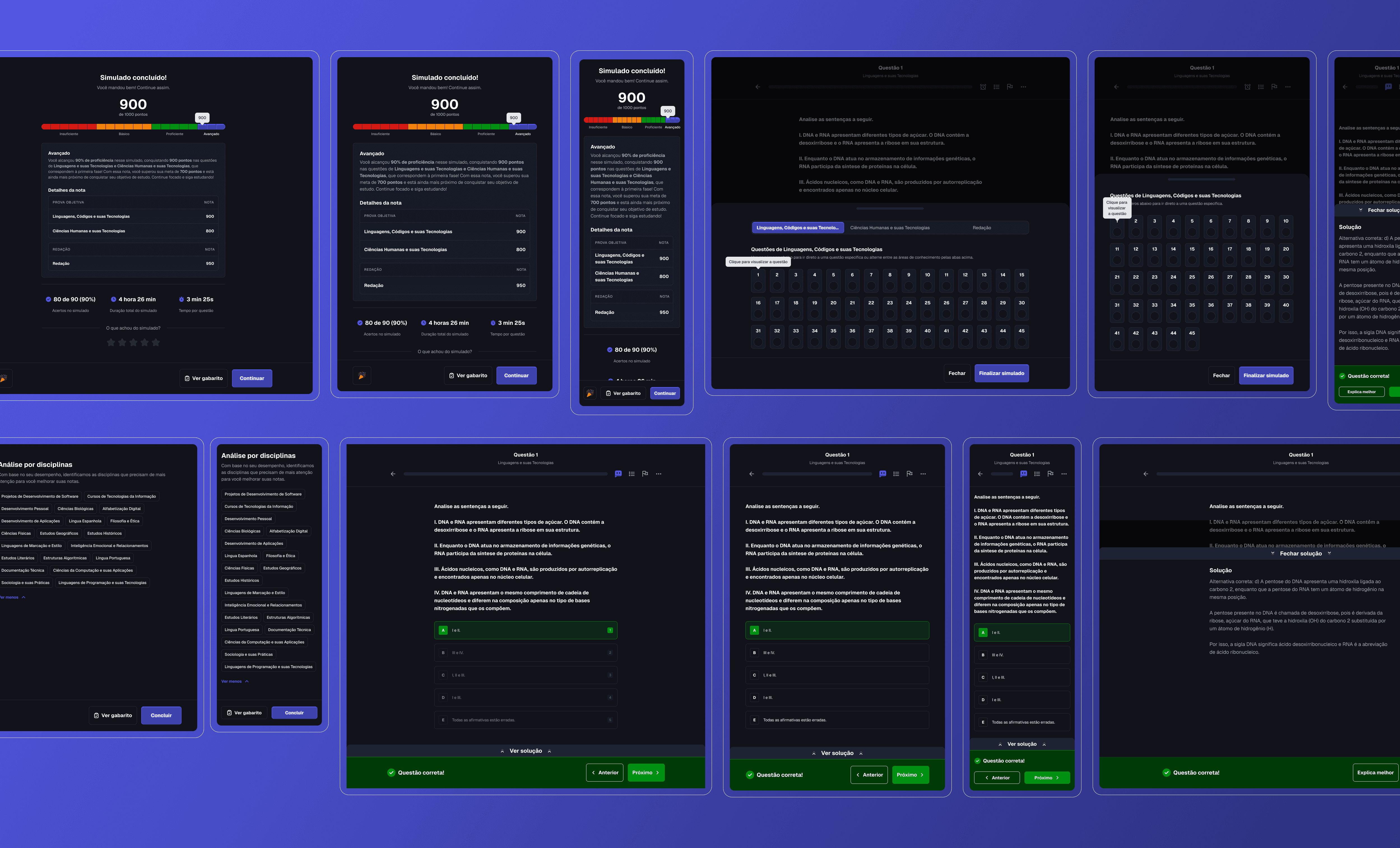
We discovered that students struggle with pacing and often lack clarity about their weak areas. The platform needed to:
Simulate real exam conditions
Track time per question
Highlight strengths and weaknesses
Offer adaptive recommendations
This required building an experience where every interaction generated actionable feedback.
2. Adaptive Learning + Clear Data Visualization
Personalization at scale was central to GenieX’s value proposition.
The AI dynamically recalculates study routes based on performance, applying high-performance learning techniques such as spaced repetition and interleaved practice. However, personalization without transparency creates distrust.
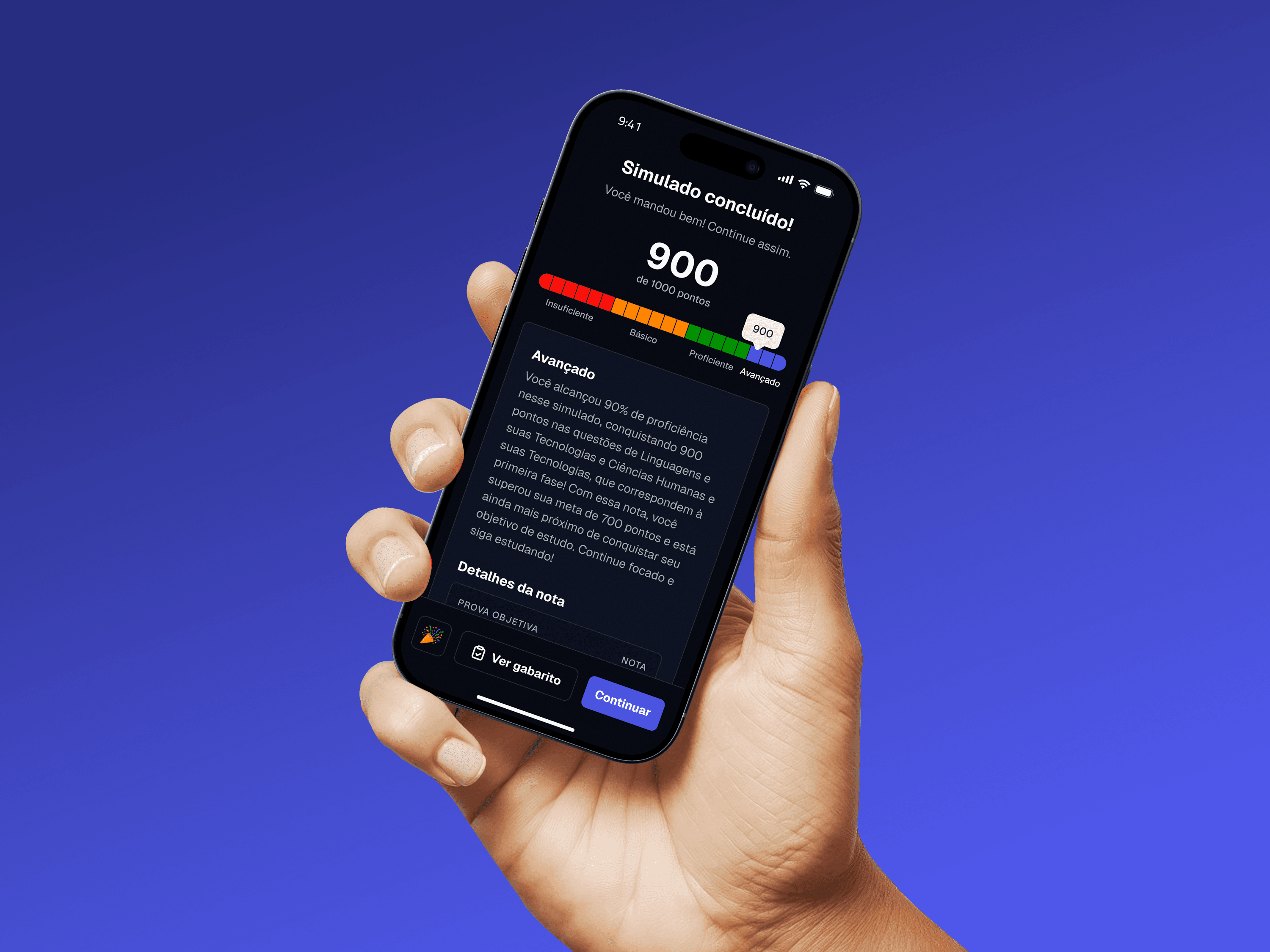
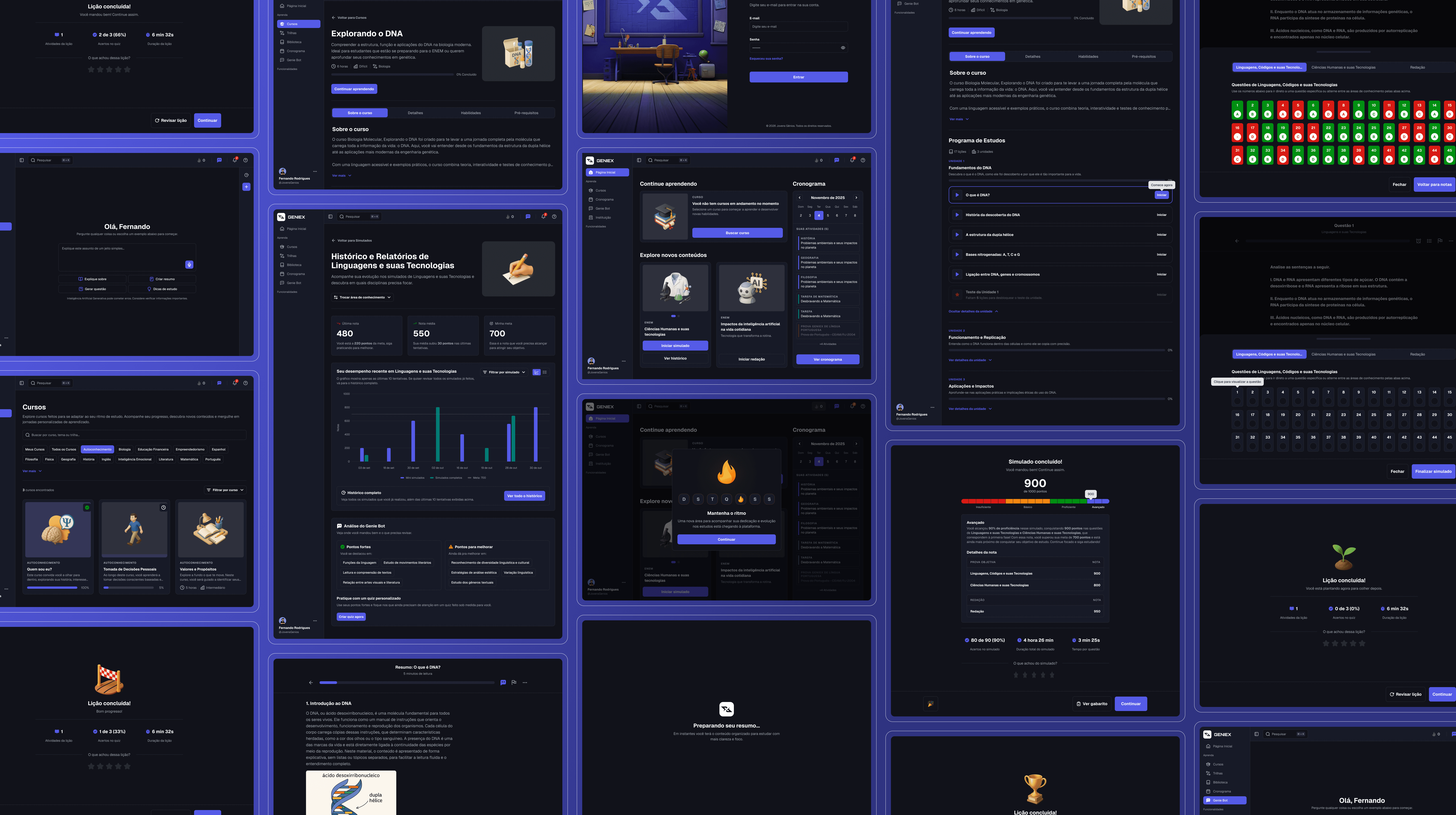
To solve this, I designed a Data Visualization layer where students could clearly track their evolution over time, performance by subject, and proficiency progression. The goal was to transform raw data into motivational insight.
The platform integrates measurable learning improvements, including:
9.918-point learning delta for engaged students
71.18% of engaged students reaching adequate proficiency
4.25x higher learning outcomes compared to control groups
These metrics reinforced the product’s academic credibility.
3. The Writing Experience (Essay Challenge)
The essay component presented one of the most complex UX challenges.
ENEM essays are handwritten, but GenieX operates digitally. The difference between typing speed and manual writing speed significantly impacts realism and preparation.
To address this, we:
Conducted multiple usability tests
Developed a hybrid timing logic system
Implemented calibration exercises where students manually write texts and then type them to establish a personalized time ratio
Applied AI-based corrections aligned with ENEM’s competency framework
The objective was not just to measure time, but to simulate cognitive load and provide high-quality, immediate feedback while respecting exam dynamics.
This solution will continue evolving, but it established a strong foundation.
4. Building a Scalable Design System
From a development perspective, we built the interface using Tailwind + Shadcn as the foundation for a scalable and flexible design system.
The focus was:
Development efficiency
Fast iteration cycles
Consistent UI patterns
Controlled customization for institutional branding
This allowed us to deliver traction quickly without sacrificing structure or product identity.
Results
GenieX successfully launched as a fully operational product built from the ground up, aligned with both student performance goals and institutional expectations.
Key outcomes include:
A validated adaptive study system aligned with ENEM structure
Data-driven student dashboards increasing clarity and engagement
AI-powered essay correction reducing educator workload
Strong academic performance indicators backed by measurable learning gains
A scalable UI system enabling continuous product evolution
Most importantly, the platform established a clear positioning:
GenieX is not just a content repository — it is a performance optimization system for large-scale academic exams.
This project strengthened my ability to:
Translate AI capabilities into human-centered experiences
Balance student engagement with institutional KPIs
Build scalable systems from zero
Operate at the intersection of education, data intelligence, and product strategy


GenieX is an AI-powered educational platform built under the Jovens Gênios ecosystem, designed to deliver personalized ENEM preparation at scale for B2B, B2Gov, and B2C markets through adaptive study plans, intelligent assessments, and real-time performance insights.
Company
GenieX
Timeline
2024
—
2025
Role
Product Designer
Project overview
GenieX was conceived as a new product under the Jovens Gênios technological infrastructure, targeting a different audience: high school and vocational students preparing for ENEM and major entrance exams.
I joined the project alongside another designer to build the platform from scratch. Our responsibility was not only to design an attractive interface, but to transform a complex AI-driven system into a product that delivered tangible academic value to students while remaining commercially viable for institutions.
The challenge was to design an experience that balanced:
Engagement for students
Strategic academic rigor
Data intelligence
Institutional reporting needs
Extensive qualitative research was conducted with high school students actively preparing for ENEM. Through interviews and behavioral analysis, we mapped critical constraints of the exam itself: strict time limits, cognitive fatigue, question pacing (approximately 3 minutes per question), and the psychological pressure of large-scale exams.
The platform needed to simulate reality, optimize performance, and provide clear data-driven direction for improvement — not just content consumption.
Challenges
1. Designing for Performance Under Time Constraints
ENEM is not only about knowledge — it is about time management and endurance.
We discovered that students struggle with pacing and often lack clarity about their weak areas. The platform needed to:
Simulate real exam conditions
Track time per question
Highlight strengths and weaknesses
Offer adaptive recommendations
This required building an experience where every interaction generated actionable feedback.
2. Adaptive Learning + Clear Data Visualization
Personalization at scale was central to GenieX’s value proposition.
The AI dynamically recalculates study routes based on performance, applying high-performance learning techniques such as spaced repetition and interleaved practice. However, personalization without transparency creates distrust.
To solve this, I designed a Data Visualization layer where students could clearly track their evolution over time, performance by subject, and proficiency progression. The goal was to transform raw data into motivational insight.
The platform integrates measurable learning improvements, including:
9.918-point learning delta for engaged students
71.18% of engaged students reaching adequate proficiency
4.25x higher learning outcomes compared to control groups
These metrics reinforced the product’s academic credibility.
3. The Writing Experience (Essay Challenge)
The essay component presented one of the most complex UX challenges.
ENEM essays are handwritten, but GenieX operates digitally. The difference between typing speed and manual writing speed significantly impacts realism and preparation.
To address this, we:
Conducted multiple usability tests
Developed a hybrid timing logic system
Implemented calibration exercises where students manually write texts and then type them to establish a personalized time ratio
Applied AI-based corrections aligned with ENEM’s competency framework
The objective was not just to measure time, but to simulate cognitive load and provide high-quality, immediate feedback while respecting exam dynamics.
This solution will continue evolving, but it established a strong foundation.
4. Building a Scalable Design System
From a development perspective, we built the interface using Tailwind + Shadcn as the foundation for a scalable and flexible design system.
The focus was:
Development efficiency
Fast iteration cycles
Consistent UI patterns
Controlled customization for institutional branding
This allowed us to deliver traction quickly without sacrificing structure or product identity.
Results
GenieX successfully launched as a fully operational product built from the ground up, aligned with both student performance goals and institutional expectations.
Key outcomes include:
A validated adaptive study system aligned with ENEM structure
Data-driven student dashboards increasing clarity and engagement
AI-powered essay correction reducing educator workload
Strong academic performance indicators backed by measurable learning gains
A scalable UI system enabling continuous product evolution
Most importantly, the platform established a clear positioning:
GenieX is not just a content repository — it is a performance optimization system for large-scale academic exams.
This project strengthened my ability to:
Translate AI capabilities into human-centered experiences
Balance student engagement with institutional KPIs
Build scalable systems from zero
Operate at the intersection of education, data intelligence, and product strategy